MusicWeaver:把音乐编辑变成对 song program 的操作
MusicWeaver 把音乐结构从 prompt 中抽出来,写成一份可读、可验证、可修改的
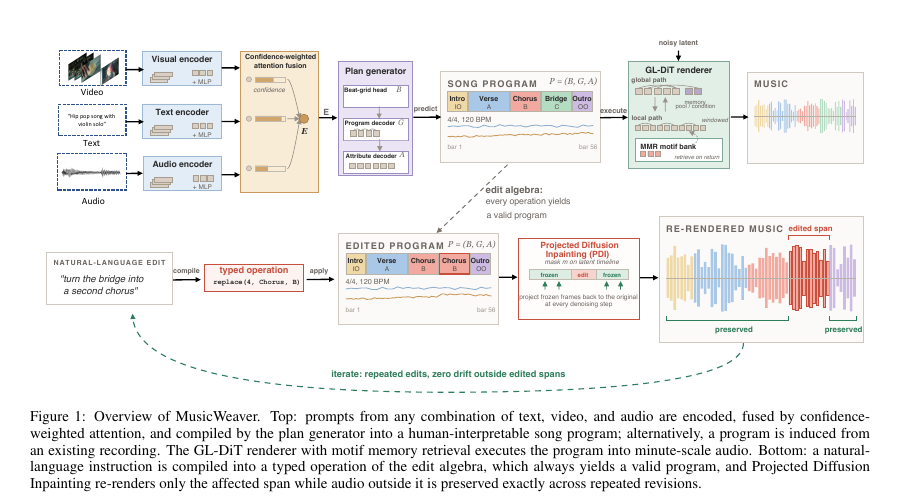
song program。这让“把 bridge 换成 chorus”先变成一个有边界的 program operation,再由 PDI 只重绘对应 latent span。PDI 的 locality guarantee 很硬,边界也很具体:它保证 dilated mask 外的 latent 不变;mask 内的 edit quality 仍靠训练,decoder / vocoder 的 receptive field 仍会影响 waveform 边界。
论文:MusicWeaver: Programmable Long-Form Music Generation with Provably Local Editing
项目:MusicWeaver project page
仓库:wangxuanchen88/MusicWeaver
当前版本
- 首次公开
- 2025-09-26 · arXiv v1
- 本文依据
- 2026-07-29 · arXiv v3 · 15 pages · 3 figures
- 版本差异
- v3 标题与方法已更新;project page 和 repository 仍显示旧标题与旧版架构说明
研究背景与前置工作
论文的 Background 在讲什么
长音乐生成已经能把 duration 拉到几分钟,但 duration 解决的是“能生成多长”。创作者真正编辑的是 section、motif、tempo、energy 和 arrangement;这些结构仍埋在 prompt 或 latent 里,无法直接 inspect、verify、revise。
另一条路线是 instruction-based audio editing。用户可以说“换掉乐器”或“提高这段能量”,模型却没有一个确定的 structural scope。一次 edit 可能改到邻近区域;连续修改时,未编辑部分也会逐轮 drift。
MusicWeaver 因此同时要求两件事:结构意图要落在作曲者能读的表示上;分钟级 renderer 要执行这份结构,并让 recurring motif 在回归时保持身份。论文选择的中间层比 MIDI 粗,只描述 form、recurrence 和 bar-level attributes,把 note-level detail 留给 diffusion renderer。
直接前置工作
Simple and Controllable Music Generation
2023-06 · Meta AI · 引用 66
MusicGen 证明单个 AR Transformer 可以在离散 audio token 上完成高质量 text / melody conditioned music generation。它提供长序列生成能力,但 section form 仍是隐式状态。
AUDIT: Audio Editing by Following Instructions with Latent Diffusion Models
2023-04 · Microsoft;The Chinese University of Hong Kong, Shenzhen · 引用 9
AUDIT 直接用 instruction 和原始 audio 作为 condition 学习编辑,是 MusicWeaver 的 editing baseline。它用训练倾向保持无关片段,没有 typed structural footprint 与逐步投影保证。
MusicMagus: Zero-Shot Text-to-Music Editing via Diffusion Models
2024-02 · C4DM, Queen Mary University of London;Sony AI;MBZUAI · 引用 1
MusicMagus 把 text word swap 映射为 diffusion latent manipulation,并加 consistency constraint。MusicWeaver 与它的差异集中在 edit scope:前者先修改显式 program,再从 program footprint 得到 mask。
Long-form Music Generation with Latent Diffusion
2024-04 · Stability AI · 引用 5
这项工作把 latent diffusion 的 full-context generation 拉到 4 分 45 秒。MusicWeaver 继承“压缩 latent 承担长序列”的路线,新增显式 form、bar-level control 和 motif memory。
首次公开取 arXiv v1。引用数使用 OpenAlex 对应 arXiv DOI 的
cited_by_count,查询于 2026-08-14;同一论文的会议版本可能被 OpenAlex 分成另一条记录,因此这里只作为统一口径的动态快照。
论文贡献:作者原文与 AI 总结分开看
论文在 Introduction 把贡献列成 4 项。
Introduction 原文贡献翻译:
- 论文把音乐创作重述为 program-guided generation,并提出两阶段 MusicWeaver:human-interpretable、multi-level song program 位于 creative intent 与 rendered audio 之间。
- 论文把 composer-style editing 形式化为 typed plan operations 的代数;每个 operation 都生成 well-formed、renderable plan。Projected Diffusion Inpainting 在构造上保证 repeated revisions 后 edited span 外的内容精确保留。
- 论文设计带 Motif Memory Retrieval 的 Global-Local Diffusion Transformer,在分钟尺度同时处理 long-range structural memory、high-resolution synthesis,以及一致但有变化的 motif return。
- 论文加入 existing recording 的 plan induction、把自然语言编译为 validated operations 的 editor,以及经 human judgment 验证的 plan-faithfulness / edit-fidelity metrics。
AI总结的论文贡献:
song program成为整个系统的 contract:planner 只能生成 valid program,editor 只能提交 admissible operation,renderer 接收同一份 program,evaluation 再检查 audio 是否执行了它。- typed edit algebra 负责确定“哪些 bar 可以变”,PDI 负责把这个 symbolic footprint 变成 latent mask,并在每个 denoising step 强制满足冻结约束。
- GL-DiT 把分钟级 structure 和局部声学细节拆到 global / local paths;MMR 单独处理 recurring motif 的身份保持。这个拆分有消融支持,但论文实现尚未公开,复现链条仍不完整。
一份 song program 到底写了什么
整套系统只有一个核心中间表示:
B=(m,T_b,ω) 是 beat grid:meter、总 bar 数、per-bar tempo curve。它把“第 17–24 bar”确定地映射到 audio / latent timeline。
G={(s_k,ℓ_k,r_k)}_{k=1}^{K} 是 form track。每个 segment 有 section type s_k、长度 ℓ_k 和 motif id r_k。两个 segment 共享 motif id,代表 renderer 应该把它们实现为同一材料的不同出现;NEW 引入新 motif。
A={a_t}_{t=1}^{T_b} 是 bar-level attributes:
分别对应 harmony、groove、energy、density、variation。variation 后面还会控制 MMR conditioning 强度。
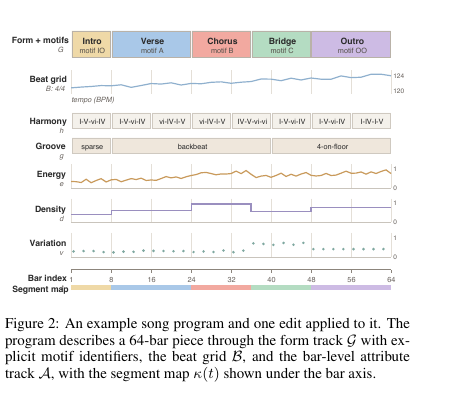
Figure 2 应该横着读:最上方是 section 与 motif identity;beat grid 决定 musical time;harmony / groove / energy / density / variation 都按 bar 对齐。这个粒度足以表达“换 section、复用 motif、改局部能量”,同时没有把 program 膨胀成完整乐谱。
Program validity 有四个条件:segment lengths 正好铺满 T_b;每个 bar 的 attributes 都在定义域内;所有非 NEW motif 都能指向更早出现的 motif;tempo curve 完整且有界。planner 在 decoding 时 mask 掉超出剩余 bar budget 的长度,并把 motif vocabulary 限制为既有 ids + NEW,因此生成阶段也只能输出 valid program。
EB=(m,T_b,ω)G={(s_k,ℓ_k,r_k)}A={a_t}代码状态:官方 repository 在 commit 52dcd7346c78326af3bc16ffec32749a1b5eb18a 下只有 README.md 和四张图片。README L21–25 只嵌入 framework figure,没有 planner、GL-DiT、MMR、PDI、loss 或 evaluation implementation。这里没有可提供的模型结构代码行。
Edit algebra:先把修改范围变成可计算对象
MusicWeaver 定义五种 typed operations:
Plan operations
REPLACE(k,s′,r′)k 的 type / motif长度不变INSERT(k,s,ℓ,r)k 前插入新 segmentbar count 增加DELETE(k)RETAG(k,r′)SETATTR(t₁,t₂,f,x)每个 operation 都有 footprint σ(o),即它允许改变的 bars。operation sequence 在一次 re-render 前执行时,最终 footprint 是各 operation footprint 的 union。beat grid 再把这些 bars 映射到 latent frames。
这个 algebra 的证明只处理 program validity:如果 P 有效,且 operation 的 index、length、attribute value 合法,那么 operation 之后 W1–W4 仍成立。它保证 program 不会被改坏;audio edit 是否好听、是否真的实现 instruction,仍由 compiler、renderer 和 evaluation 决定。
Natural-language editor 的任务也因此变窄:LLM 只能输出 operation calls,validator 在真实 program state 上 replay admissibility;失败后允许一次 repair,仍失败就 reject。300 条 instruction 上,首次 compilation success 为 88.7%,一次 repair 后为 96.0%。模糊的 temporal reference 是主要失败源。
PDI 的“provably local”具体保证了什么
PDI 从 program footprint 得到 binary mask m。为了避免 seam,mask 两侧还会扩张 β 个 transition frames;后面的 guarantee 始终针对扩张后的 mask。
给定当前 audio 的 latent z₀old,初始化时只给 editable region 加噪:
每个 DDIM step 先得到 unconstrained proposal z̃_{τ-1},再把 frozen region 投影回旧 latent:
所以对任意 m_i=0 的 frame,每一步都有 z_τ[i]=z₀old[i]。连续 edit 多轮以后,所有 edit masks union 之外的 latent 仍与最初版本一致。这个结论直接来自 overwrite operation,不依赖 denoiser 学会“自觉保持”。
Guarantee 有三层边界:
Locality guarantee 的边界
z₀old数学保证落在这里Table 4 把 16 latent frames 写成约 0.68 s,据此可算 latent rate 约 23.5 Hz。论文报告 decoder horizon 外 spectral distance 为 0.000;三位小数的 metric 结果支持“没有可测 drift”,还不足以单独证明 waveform bitwise identical。transition width β、mel-VAE / vocoder 的具体 receptive field 和 sample-level equality 检查方法也没有给出。
INSERT / DELETE 会改变 timeline length。PDI 先把 frozen latent spans splice 到新位置,只把 inserted region 或 junction band 设为 editable,再执行同一套 projection。
GL-DiT:global path 管 bar,local path 管 latent patch
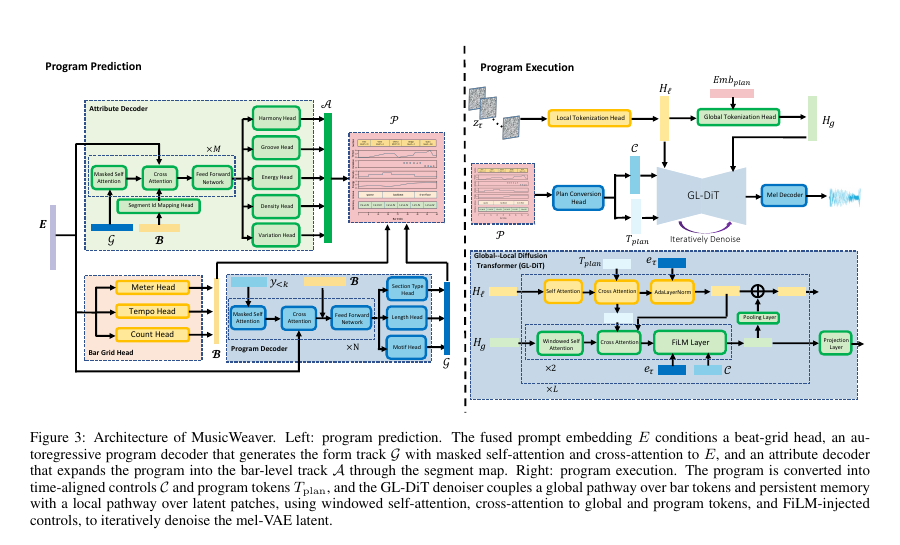
Renderer 在 mel-VAE latent 上做 conditional diffusion:
Program 被转换成两条 condition。C 把 per-bar fields 通过 beat grid resample 到 latent timeline;Tplan 是短 program token sequence,提供全局 section / recurrence 信息。
Local path 把 noisy latent 切成 non-overlapping (p_t,p_f) patches,使用 windowed self-attention;每层还 cross-attend global tokens 和 Tplan,并用 FiLM 注入 C。Global path 以 one token per bar 的 pooled local features 为主体,再加 bar-aligned plan embedding 和 persistent memory tokens,使用 full self-attention。每个 coupled block 末尾,local features 又被 pool 回 global state。
zτ(p_t,p_f) patchifyHℓC)HgTplan)ε̂MMR 处理同 motif 的重复出现。第一次实现 motif r 后,模型把对应 local tokens pool 成 V_r;后续出现通过 EMA 更新。program 再次调用 r 时,V_r 作为额外 cross-attention context 注入 local layers。v_t 控制 conditioning strength,让 return 可以接近原 motif,也可以保留变化。
论文给出的 renderer 配置
- GL-DiT
- 12 global-local blocks · width 768 · 12 heads
- Memory
- 每个 block 16 memory tokens
- Audio
- 24 kHz · 128-bin mel spectrogram
- Diffusion
- 1000 training timesteps · 50-step DDIM sampling
- Training
- 600K updates · 8 × NVIDIA A100-80GB · 结果默认 3 seeds
论文没有给 (p_t,p_f)、mel-VAE architecture / latent shape、frozen multimodal encoder 名称、MMR EMA coefficient、optimizer、learning rate、batch size、mask dilation β 或完整 training objective。官方代码也未发布。这些缺口直接影响复现 Figure 3 和 PDI。
Program labels 从哪里来
训练集没有人工 song program。论文先对 audio 做 plan induction:beat / downbeat tracker 给 B;audio embedding 的 self-similarity 给 section boundaries;segment classifier 预测 section type;segment embedding clustering 产生 motif ids;chord、onset pattern、loudness、onset count 和 embedding distance 估计 bar attributes。
然后 planner 用 teacher forcing 学这些 induced programs:
所以 planner 的 supervision 上限由 induction pipeline 决定。600 个手工标注 clips 上,beat tracking 为 94.2 F1;section boundary 78.1 F1;section type 74.6%;motif link 70.2 F1;chord 68.4%。论文按 induction confidence 给 plan losses 加权,用来减轻 noisy labels。
这份 induction pipeline 还承担 PF evaluation:生成 audio 被重新 induction,再与输入 program 比较。pipeline 在评测前 frozen,避免针对 test output 调参;但 training labels 与 PF evaluator 仍共享同一套分析偏差。human correlation 和 corrupted-plan experiment 提供了补充证据,无法完全消除这个 coupling。
训练数据里藏着一个很大的 duration 问题
训练使用 VGGSound-Caps + V2M-Caps,过滤后约 220K clips / 610 hours。据论文数值计算:
平均 clip 约 10 秒;长生成评测却覆盖 60 / 120 / 180 s。MW-Long 有 500 text prompts 和 200 video-text prompts,输出按 3 seeds 平均。
这意味着论文的 minute-scale claim 很大程度依赖 program、bar-level global path 和 patch-local computation 的外推。正文没有说明如何把约 10 秒 training clips 拼成多分钟 training sequence,也没有 duration curriculum / long-context finetuning ablation。GL-DiT 能在计算上处理 180 秒,是否真正从训练数据学到了分钟级 progression,仍需要更清楚的训练 protocol。
实验真正证明了什么
生成质量:结构优势比 fidelity 优势更稳定
所有 baseline 使用 matched duration、loudness normalization 和统一 metric implementation;appendix 还写了 matched sampling budget。参数量、training data 和 training compute 没有对齐。
MusicCaps · Text-to-Music
11.23FAD 1.73Align .23SCS 76.811.64FAD 1.62Align .24SCS 80.311.58FAD 1.51Align .23SCS 83.2MusicWeaver 的 T2M FD 仍略差于 AudioX,alignment 仍略差于 ACE-Step。它最稳定的领先项是 SCS,FAD 也最好。论文的结果更适合表述为“在 fidelity / alignment 不掉队的条件下,结构指标领先”。
V2M 上同样有条件:MusicWeaver 的 FD 24.38 逊于 AudioX 的 23.25,但 FAD 2.12、alignment .24、SCS 81.5 更好。TV2M 上 MusicWeaver 的 FD / FAD / alignment / SCS 全部领先 AudioX。
180 秒时,差距才真正拉开
MW-Long · 60 → 180 seconds
73.4 → 61.5下降 11.976.9 → 63.1下降 13.880.3 → 70.2下降 10.184.1 → 80.8下降 3.3180 秒时 MusicWeaver 的 SCS 比 ACE-Step 高 10.6,FAD 是 2.06 vs 2.57。这组结果支持 explicit program + memory 对 duration degradation 的作用;训练数据 duration 与新指标实现缺失仍限制结论强度。
PDI 的价值集中在连续编辑
300 条 composer-style instruction 上:
Editing benchmark
73.2IOI 59.4EFS 68.874.1IOI 60.2EFS 67.875.6IOI 61.7EFS 70.478.8IOI 65.8EFS 73.8连续 8 次 edit 后,MusicWeaver 的 outside-region spectral distance 是 .014,MusicMagus 是 .171,约高 12.2×;decoder horizon 外 MusicWeaver 报告 .000。PDI 的强项在 repeated revision workflow 中最清楚。
Ablation 支持模块分工,也暴露一处文字与表格冲突
Table 6 · MusicCaps ablation
83.2EFS 72.6FAD 1.51PF 84.774.6EFS 70.9FAD 1.58PF 76.170.2EFS 66.8FAD 1.85PF 74.877.0EFS 70.8FAD 1.55PF 80.583.0EFS 63.5FAD 1.63PF 84.182.7EFS 67.2FAD 1.60PF 83.8MMR 去掉后 SCS 降 6.2、PF 降 4.2,符合它负责 recurrence 的解释。soft-mask PDI 主要打击 EFS,SCS / PF 几乎不变,也符合 locality module 的定位。
论文 prose 写“global path removed 时 SCS drop 最大”,Table 6 的数字却显示 w/o local path 从 83.2 降到 70.2,下降 13.0;w/o global path 下降 8.6。表格支持 local path 同时承担 fine fidelity 和大量 structure signal。当前 v3 没有解释这处冲突。
Renderer 确实在用 program
Table 12 · Plan quality
76.8PF 58.783.2PF 84.786.5PF 89.362.4PF 41.655.8PF 35.2Shuffled / random program 会让结构和 faithfulness 明显崩掉,这排除了 renderer 完全忽略 plan 的解释。Induced ground-truth plan 比 predicted plan 更好,也把 induction / planning error 与 rendering capacity 分开了一部分。
新指标经过 human correlation,但实现仍不够完整
SCS 等权汇总 beat-onset coupling、tempo stability、boundary clarity、motif recurrence、section cohesion。EFS 组合 edit constraint satisfaction 与 change localization。PF 比较输入 program 与从生成 audio 重新 induction 的 program。
20 位有 music production / MIR 经验的参与者中,SCS 与 human structure rating 的 Spearman correlation 为 .72;EFS 与 edit correctness / locality 是 .74 / .71;PF 与 structure 是 .66。
论文没有完整给出 EFS 中 rΔ 的计算、α、feature map Φ 的实现,也没有 SCS 各 detector / normalization 的可执行配置。当前 repository 没有 metric code。相关性支持 metric direction,绝对分数还不能被独立复算。
用户研究说明 program interface 减少了试错
20 位参与者完成 30 个 editing tasks:instruction baseline 平均需要 3.4 次 regeneration、181 s;MusicWeaver 是 1.8 次、97 s。Edit controllability 从 63.5 提到 81.2,local preservation 从 61.8 提到 82.6。
这是 interface 层最有价值的证据:program diff 让用户在 render 前看见系统将执行什么。样本量仍小,且 repository / demo 没有提供可复查的交互实现。
Codex 的判断
最可复用的设计是把自然语言放在 compiler 前,把可验证的 operation 放在 renderer 前。LLM 可以误解 instruction,但它不能绕过 typed schema 和 validator 直接修改 program。这个结构适合任何需要局部、可回滚、可审计生成的系统。
PDI 的 guarantee 也很干净。它没有声称 denoiser 学会了完美 locality;sampler 每一步都强制覆盖 frozen latent。真正需要继续验证的是 projection 的版本:论文始终写入 clean z₀old,没有公开代码说明是否在实际采样中使用 timestep-matched noised source latent。
目前证据最薄的地方有四个:约 10 秒平均 training clips 如何支撑 180 秒 generation;GL-DiT / VAE / metric 的关键实现缺失;Table 6 的文字与数字冲突;project page / repository 仍停在旧标题与旧架构。
Codex 最想补的实验:
- 固定 model / data,只改 training context length,直接测 10、30、60、180 秒训练对长程 SCS 的贡献。
- 用独立 MIR pipeline 和人工 annotation 复算 PF / SCS,隔离 induction evaluator 的共享偏差。
- 对 repeated
INSERT / DELETE做 waveform sample equality、boundary perceptual test 和真实 DAW round-trip,而不只报 spectral distance。 - 分开比较 clean-latent projection、timestep-matched projection、soft blending,测 seam、inside-mask quality 和 denoising stability。
Takeaway
MusicWeaver 最重要的想法是把音乐创作接口做成一份可执行的
song program:structure 由 program 明示,edit scope 由 typed operation 确定,PDI 再把这个 scope 强制落实到每一步 latent sampling。形式保证成立;分钟级学习机制和复现细节仍需要代码与更完整的 training protocol 支撑。
AI 的来源与证据边界
- 论文事实:song program、edit algebra、PDI、GL-DiT、MMR、training setup、Tables 1–18 均依据 arXiv v3 正文与 appendix。
- 项目事实:project page 和 repository 仍使用旧标题;固定 commit 的仓库只有 README 与图片,没有模型或 metric implementation。
- 据论文数值计算:
610 hours / 220K clips ≈ 9.98 s/clip;16 latent frames / .68 s ≈ 23.5 Hz;8 次 edit 时.171/.014 ≈ 12.2×。 - Codex 的判断:PDI guarantee 的边界、training duration gap、induction evaluator coupling、Table 6 prose/table 冲突和复现缺口属于证据审计,不是作者原始贡献。